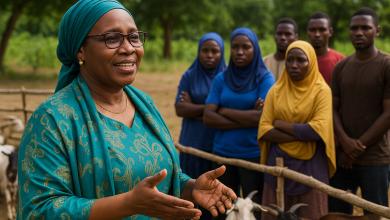
The Jigawa State government said it had curved out 57 grazing reserves as part of measures to tackle farmer-herder clashes in the state.
The deputy governor of the state, Alhaji Umar Namadi, who stated this on Tuesday at a security summit in Guri, said boreholes were provided in all the reserves.
He said the state had distributed over 62 motorcycles to the leadership of farmers and herdsmen for easy transportation.
He advised both farmers and herdsmen to live in peace with one another and warned against lawlessness.
The state Commissioner of Police, Mr Bala Sanchi, said the recent clashes between farmers and herdsmen were major setbacks to the peaceful coexistence the state was previously known for.
He said that investigation by the command revealed that both farmers and herdsmen were guilty of the reoccurring crises.
Sanchi blamed the farmers for planting crops on cattle routes, while herdsmen were also guilty of destroying farmlands.
The commissioner noted that socio-economic development could only occur if both farmers and herdsmen conducted their businesses within the ambit of the law.
He called on the groups and stakeholders to inform him about any alleged violation of the law by his men and officers.
Earlier, the chairman of Guri Local Government Mr Barkono Jaji, said clashes between farmers and herdsmen had worsened in the area over the last 10 years.
He appealed to the state government to constitute a committee to pay compensation to farmers, whose farms were destroyed in the recent crises in the area.
The News Agency of Nigeria (NAN) reports that the summit was organized in response to recent attacks by suspected herdsmen on residents of Zagari and Dorowaji villages in the area where about 800 persons were allegedly displaced by the attack.
Others who spoke in the summit included traditional rulers, religious leaders, farmers, and herders.