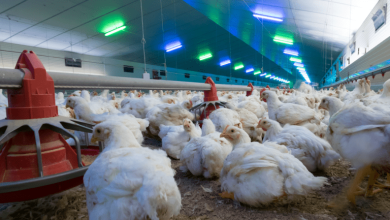
House conditions at chick placement and during brooding
Temperature and relative humidity in relation to chick comfort
In order to achieve the correct environmental conditions when chicks are placed, houses should be heated to an air temperature of 30C (86F) at least 24 hours prior to chick placement, with the litter temperature being 28 to 30C (82 to 86F). The relative humidity (RH) should be 60 to 70 percent and temperature and RH monitored routinely to ensure a uniform environment. In colder climates, it may be necessary to preheat the house for 36, or even 48 hours, to achieve the correct conditions. Chicks must be delivered to the farm as soon as possible after hatching and be provided with immediate access to feed and water.
Daily records of temperature and RH must be maintained throughout the life of the flock. These records, combined with daily observations of bird behaviour, can be used to adjust the house environment and ensure the birds are comfortable at all times. This is critical during the early period in the chick’s life (up to 12 to 14 days) when the birds are unable to regulate their body temperature (Figure 4). The stockman will be able to feel the house temperature, as well as listen to the vocalisations of the birds and observe their distribution within the house, to help determine if the chicks are comfortable.
 Ventilation
The correct minimum ventilation rate should be established prior to the chicks being placed. Minimum ventilation supplies adequate fresh air, removes excess moisture, and limits the build-up of potentially harmful gases and airborne by-products. Inadequate minimum ventilation can lead to respiratory challenges later in the flock’s life, which may require antibiotic treatment. No matter what ventilation system is being used (natural or power ventilation), it is important that the correct monitoring is being done to ensure that equipment is operating properly and air quality is being maintained. The stockman should assess the house for adequate ventilation by asking the following questions:
• Are the birds vocalising as normal, or can snicking/sneezing or other respiratory noises be heard?
• Are the fans running properly, or do the bearings sound noisy or the belts sound loose?
• Does the air feel humid, hot or cold?
• Is there enough or too much air speed?
• Does the house smell of ammonia?
The importance of getting a good start
Providing chicks with the correct environmental and brooding conditions will ensure all of their nutritional and physiological requirements are met. Meeting these requirements promotes early development of feeding and drinking behaviour and optimises gut, organ and skeletal development to support body-weight gain and bird health throughout the life of the flock.
Challenges during this early stage of life, caused by inadequate cleaning and disinfection procedures or incorrect house conditions at placement, will impact future bird health, flock performance and uniformity. A poor start will deliver a variable flock later in life, which may have poorer performance and health and be more challenging to manage.
Broiler stockmen have a number of tools at their disposal to monitor brooding conditions and their effect on chick comfort and appetite development, body-weight gain and flock uniformity. These tools include:
Measuring vent temperature. This is an excellent way of determining if environmental conditions are correct for the chicks. In the first 4 to 5 days after hatch, vent temperature should be 39.4 to 40.5C (103 to 105F). Vent temperature should be measured on at least 10 chicks from at least 5 different locations in the house for the first 4 to 5 days after placement.
 Assessment of crop fill at key times after placement. This is a useful means of determining early appetite development and checking that all chicks have found feed and water. Crop fill should be monitored during the first 48 hours, but the first 24 hours are the most critical. An initial check two hours after placement will indicate if chicks have found feed and water. Subsequent checks at 8, 12, 24 and 48 hours after arrival on the farm should also be made to assess appetite development. Samples of 30 to 40 chicks should be collected at three or four different locations in the house.
Crop fill assessment guidelines
Recording individual body weights. It is good management practice to record individual body weights and determine the co-efficient of variation (CV%) of a sample of chicks at placement and then again at seven days of age. This will allow early flock uniformity and its development through the brooding period to be established, and will also provide an indication of the adequacy of brooding management practices. At day-old, it is recommended to individually weigh all the chicks in one box from each parent stock source flock to determine initial flock uniformity. At 7 days of age a sample of individual weights from 100 chicks should be recorded again. The change in CV% between placement and seven days of age can provide an indication of the effectiveness of the brooding set-up.


Using change in CV% between placement and 7-days of age to determine the effectiveness of the brooding set-up.