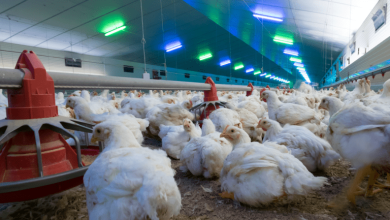
Charlie Simpson rears 542,000 broilers each crop at Lower Heath Farm, Whitchurch, Shropshire, and introduced a comprehensive water treatment regime about 3 years ago.
Challenges of borehole water
“We use borehole water which I know isn’t the best in the world,” he says. “We have it tested every 6 months, and have an ultraviolet steriliser in every shed.” The water is high in manganese, iron and sulphate, so Mr Simpson uses a reverse osmosis unit to remove trace elements; the waste water is used for washing down yards. “Hygiene is very important, but water hygiene is often overlooked.”
Turnaround – flushing all the lines
At turnaround, Mr Simpson flushes all the lines – including underground pipes – out with a hydrogen peroxide-based product, leaving it for 12 hours before flushing that out with fresh water, which is done again just before the birds come into the sheds.

After stocking – adds chlorine and organic acids to water
Once stocked, he adds chlorine and organic acids to the water using an LMS automated dosing system, lowering the pH from 7.4 to around 5.2. “Clean water is probably the most important ingredient you give to your chickens, especially if you take into account how much of their body mass is made up of water,” explains Mr Simpson. “That’s why I’m happy to spend money on getting it right.”
Water cost is £0.02 per bird
Mr Simpson reckons he spends about 2p/bird on his water. “It easily pays for itself through the benefits to gut health,” he says. “We now never have to top up bedding and we have very good pododermatitis scores. In addition, the water lines and drinkers are really clean; before we always had a slimy layer – now we don’t get any biofilm build-up.”
Probiotics and essential oils in feed
As well as treating the water, Mr Simpson adds probiotics and essential oils to feed to boost the birds’ gut health and immunity at around 3 weeks of age. “At this time the birds are undergoing a feed change, being vaccinated against Gumboro disease and also going through their optimum growth phase,” says his vet Suzie Ackerley from St David’s Poultry Team. “This combination means intestinal health can suffer; the essential oils help to support the birds by stabilising the intestine and reducing leakage of bacteria into the bloodstream.”
A fimbriae blocker – to reduce E. coli attachment
Mr Simpson is also experimenting with Zoolac – a fimbriae blocker – at day-old to try and reduce E.coli attachment. “The stronger and healthier they are the better. We can’t use any starter medication any longer so we’re trying to give the birds the cleanest and best quality water so as not to introduce any harmful bacteria along the way.”
Slashed antibiotic usage by 70-80%
Having implemented the changes, Mr Simpson has slashed his antibiotic usage by 70%-80% in just 3 years, and qualified for Aviagen’s coveted ‘400 Club’ – which recognises the highest performing broiler producers in the country – 3 times in a row. “It’s really a combination of everything pulling together,” says Mr Simpson. “It’s all about prevention rather than cure.”
Author: Olivia Cooper